Friday, September 29, 2006

Thursday, September 28, 2006
Leap Into The Void

With the first, and possibly only issue of Gestalt near completion, the artist practices leaping into the void.
Monday, September 18, 2006
America on the Brink. Pt. Four
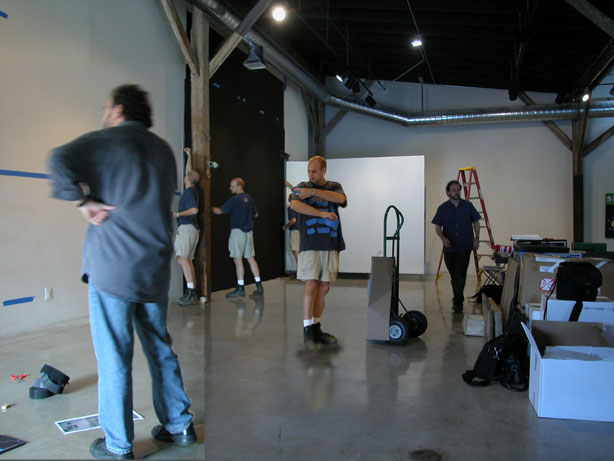
Randall Packer and I before the excavation of the grave two weeks ago in Athens. Or, fun with Photoshop. It's amazing what 20-25 minutes will get you between five snapss and reducing the image to 72dpi. Call it a draft.
Now before people e-mail in protest that I am ripping off Inigo Navarro Davilla at Irvine Contemporary Art, I'd just like to preface I've seen his kind of work before from a guy in New York a few years back by the name of Anthony Goicolea.
It's not the medium; it's what you choose to say with it.
Wednesday, September 13, 2006
America on the Brink: pt. Three
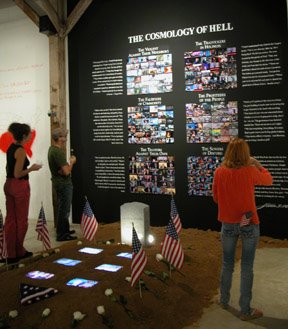
This has been my summer project. The extension of America’s Grave, which was first exhibited Jan 20th, 2006, one year after “the inauguration of death,” as my colleague and the creative director of the piece, Randall Packer, puts it. This is the piece as it went on display Sept. 9th, 2006, in Athens, GA.
The piece is fairly text heavy, between Randall’s blog chronicles
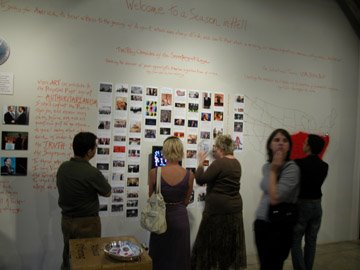 and my transcription of the cosmology of hell. We debated how attentive an audience would be to work that is so didactic. But they came in droves, stood, and read.
 The background on the piece, or how I don’t want the piece to be perceived as though we are raving lunatics: The Cosmology of Hell is based off of Dante’s Inferno. The original grave, as created by the US DAT, depicted six levels of hell: 1) The Violent Against Their Neighbor, 2) The Traffickers of Holiness, 3) The Falsifiers of Commodity, 4) The Profiteers of the People, 5) The Traitors Against Their Own, & 6) The Sowers of Discord. These levels of hell are represented through the media with television clips from 1) 9-11, Iraq, Afghanistan, Palestine; 2) crooked televangelists; 3) Supernatural Commercials; 4) Katrina; 5) The Administration; 6) Bill O’Reilly.
My job, when I first started working with the Department was to scrub, capture, and edit video and concoct a way to bury the monitors and DVD players in the dirt so they could last a run of two months.
For Athens, the piece had already expanded and additional narratives were included. The Cosmology of Hell had to be included. Below is the text on the wall, pulled from the audio clips of America’s Grave. The audio of the grave is designed in such a matter to allow chance. All six monitors are edited to different lengths, and the audio levels are raised and lowered to emphasize specific sound clips. All six monitors could play at once or the grave can go silent. Relationships form between them. The text below is an attempt to create a discordant linear narrative of the piece, as interpreted by a character I adopted for the trip to Lynchburg, VA: John 3:16. The numbers, which were originally reflective of the order of specific quotes extracted from their various levels of hell, have become an arbitrary assignment, but a deliberate visual aesthetic that communicates how text, even those of wholly writ, when removed from their source, or taken out of context, can be completely polluted of their intention and meaning.
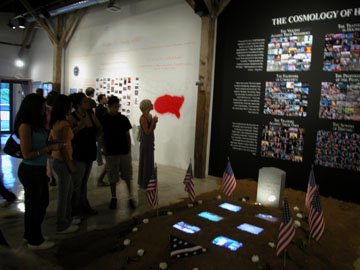
1.1Oh my God. The mighty World Trade Center tumbling down. People saying I love you and then the line going dead. The loss of life is utterly unbelievable. 1.2Today they brought that terrible hatred to the United States of America. 1.3Very seldom a military plan goes according to plan. We are going to have to hold everyone accountable. 1.4Enduring freedom is an inexpensive operation, estimated at less than $2.5 billion. 1.5Allah be praised, it’s a win-win situation -- I hope I live.
2.1I don’t understand why God let this happen to me. 2.2Aww you dummy. Shut up! He’s being God! We did not evolve. We were created by the genius of God. 2.3But, one misstep, one change in the direction of the wind, and I am into the abyss. 2.4There are good days ahead for each of you, I promise. You better get yourself ready. You profess Christ but you do not possess Christ. 2.5When you’ve lived your life and you’ve shared the good news of Jesus Christ... bombs away!
3.1Tell us what you don’t like about yourself. It’s time to start believing, start getting things back to normal the moment you call. 3.2The medicines. The plastic. The materials. Things that make modern life modern. Less of it is stored in the body as fat. 3.3 It’s not only brought us closer together but it has definitely deepened our faith. Order today. And see your world in high definition. 3.4I’m not putting it off a minute longer. This TV really sucks! You know what to do.
4.1I tell ya it’s gotten to the scary level here. I’m just looking to make sure we’re not going to get whacked in the head with anything. 4.2For those of you who are concerned about whether or not we’re prepared to help, don’t be - we are. The government has declared martial law. There are no more civil rights. 4.3We lost everything. Everything. It’s crazy. That’s gotta leave you feeling pretty helpless. 4.4This storm affects everyone. And Brownie, you’re doing a heckuva job!
5.1But we need to be alert. We will not tire. We will not falter. And we will not fail. 5.2There’s an old poster out west that said, “Wanted: Dead or Alive.” These demands are not open to negotiation or discussion. 5.3And then there came a day of fire. A fire in the minds of men. We will smoke them out of their holes. 5.4So help me god. My job is to protect America and that’s exactly what I’m gonna do, even though I walk through the valley of the shadow of death.
6.1This is World War Four: the war for the free world. It is an attack on American tradition. 6.2Be American. Celebrate Christmas. People spend more money. Jesus makes people want to spend money. 6.3This is what the culture war is all about. 6.4Generally we’re against rape. To an obsessive element, you know, It looks like it is harmless. It’s not. 6.5So, it’s down with Christmas & up with sexual offenders. Because they’re Liberals and they throw like girls. 6.6The American Media is working for the enemy.
Wednesday, September 06, 2006
America on the Brink: pt. Two
Monday and Tuesday have evaporated. 26 hours of installation and we still do not appear to be very far along. Transcribing the text of John 3:16 onto a 15'x13' wall takes time, however. Randall has busied himself with organizing and designing the wall devoted to the blog chronicles. More of that occurs today. Tomorrow we become, once again, grave diggers.
We were interviewed by the press on Monday. The author of the article asked, since there are so many Republicans in Georgia, how to go about writing this in such a manner so that it does not offend people. I suppose a grave with the death date of The USA coinciding with the second inauguration of W. can be a bit incendiary. We communicated to her that this is not an anti-Republican piece. The Republican Party is the party of Lincoln, Teddy Roosevelt and Eisenhower. Nor is this piece in opposition of religion. The piece opposes fundamentalism and the mixing of politics and religion, that the blind cowtowing to both is problematic.
When pursuing this piece it has been of great importance not to have it appear with the look of a political cartoon. Half of the gallery is filled with the work of other artists and some of them appear with the look of political cartoons. Text heavy and with a punchline. The one-liner. Take my president, please! Art and politics is a messy busy.
We were interviewed by the press on Monday. The author of the article asked, since there are so many Republicans in Georgia, how to go about writing this in such a manner so that it does not offend people. I suppose a grave with the death date of The USA coinciding with the second inauguration of W. can be a bit incendiary. We communicated to her that this is not an anti-Republican piece. The Republican Party is the party of Lincoln, Teddy Roosevelt and Eisenhower. Nor is this piece in opposition of religion. The piece opposes fundamentalism and the mixing of politics and religion, that the blind cowtowing to both is problematic.
When pursuing this piece it has been of great importance not to have it appear with the look of a political cartoon. Half of the gallery is filled with the work of other artists and some of them appear with the look of political cartoons. Text heavy and with a punchline. The one-liner. Take my president, please! Art and politics is a messy busy.
Monday, September 04, 2006
America on the Brink. pt. One
After a 12-hr. drive I am finally about to settle down in a hotel room in Athens, GA. Driving on a slight situational tour through parts of the South, en route to install the grave of America and the Dantean cosmology of hell that it has descended into, with the US Dept. of Art and Technology, has been a bit of an event.
So far we have seen two red crosses at mega churches with the words Jesus Christ written across the arm beam, a real estate sticker with some relationship to the Passion, and about 3 dozen topless dancing club billboards at such and such an exit with washing units for your big rig. (semi-truck, not the other big-rig, you sick monkey...)
South Carolina does not sell liquor on Sundays.
Georgia can only sell liquor on Sundays if the vendor is a restaurant.
So far we have seen two red crosses at mega churches with the words Jesus Christ written across the arm beam, a real estate sticker with some relationship to the Passion, and about 3 dozen topless dancing club billboards at such and such an exit with washing units for your big rig. (semi-truck, not the other big-rig, you sick monkey...)
South Carolina does not sell liquor on Sundays.
Georgia can only sell liquor on Sundays if the vendor is a restaurant.
Wednesday, August 02, 2006
Note to Gallerist: Keep the Coaster.
Coast•er n
1. a mat placed beneath a glass in order to protect a surface
2. a compact disc rendered useless
Recently I received a return from the Arlington Arts Center, responding to an exhibition submission from earlier in the summer. We all know the kind: submit an exhibition idea to the gallery complete with examples of work and a check for entry fee. Include an SASE.
In decades past this was necessary for the return of the examples in slide form. Slides, as we are all familiar, are expensive. The film is expensive to purchase. They may be expensive to take with a hired hand. They are expensive to develop and they are just as expensive to duplicate.
CDs, however, are at most $1 to produce. And the images stored on them have a specific shelf life of the one CD typically due to a specified number of image entries or due to the related nature of the work for a site-specific installation or exhibition.
However, artists may still include the SASE in the form of a business envelope despite the obvious difference in size and function from an envelope that holds a compact disc. Lenny Campello made this observation in a blog entry a number of months ago and screamed at artists about the idiocy of this phenomenon.
It is not idiocy.
It is a reflex by artists to unscrupulous gallerists who do not have the common courtesy to send a rejection letter. And there are many. In fact, this may also be the reflex of artists who have applied for real jobs with real resumes and real portfolios. Who send them out to dozens of companies (273) in eight markets (Des Moines, Lincoln, Chicago, Minneapolis, New York City, Kansas City, Milwaukee, Madison) and not hear one peep from even the lowliest of HR reps… not that I write with such experience.
While I do not suspect this to be an activity specifically of the Arlington Arts Center, why should I take the chance? I’d like to hear back from such centers of art. What makes little sense is the effort spent to return the disc. AAC was kind enough to return the coaster in someone else’s SASE - I assume someone who got a solo exhibition (and his or her penmanship was gorgeous). To balance the cruelty of the even gallerists, the good galleriest will often dig out an envelope and cough up the 78 cents to return the disc.
GALLERIES. SAVE YOUR MONEY. KEEP THE COASTER.
1. a mat placed beneath a glass in order to protect a surface
2. a compact disc rendered useless
Recently I received a return from the Arlington Arts Center, responding to an exhibition submission from earlier in the summer. We all know the kind: submit an exhibition idea to the gallery complete with examples of work and a check for entry fee. Include an SASE.
In decades past this was necessary for the return of the examples in slide form. Slides, as we are all familiar, are expensive. The film is expensive to purchase. They may be expensive to take with a hired hand. They are expensive to develop and they are just as expensive to duplicate.
CDs, however, are at most $1 to produce. And the images stored on them have a specific shelf life of the one CD typically due to a specified number of image entries or due to the related nature of the work for a site-specific installation or exhibition.
However, artists may still include the SASE in the form of a business envelope despite the obvious difference in size and function from an envelope that holds a compact disc. Lenny Campello made this observation in a blog entry a number of months ago and screamed at artists about the idiocy of this phenomenon.
It is not idiocy.
It is a reflex by artists to unscrupulous gallerists who do not have the common courtesy to send a rejection letter. And there are many. In fact, this may also be the reflex of artists who have applied for real jobs with real resumes and real portfolios. Who send them out to dozens of companies (273) in eight markets (Des Moines, Lincoln, Chicago, Minneapolis, New York City, Kansas City, Milwaukee, Madison) and not hear one peep from even the lowliest of HR reps… not that I write with such experience.
While I do not suspect this to be an activity specifically of the Arlington Arts Center, why should I take the chance? I’d like to hear back from such centers of art. What makes little sense is the effort spent to return the disc. AAC was kind enough to return the coaster in someone else’s SASE - I assume someone who got a solo exhibition (and his or her penmanship was gorgeous). To balance the cruelty of the even gallerists, the good galleriest will often dig out an envelope and cough up the 78 cents to return the disc.
GALLERIES. SAVE YOUR MONEY. KEEP THE COASTER.
Saturday, July 15, 2006
Christenberry at SAAM
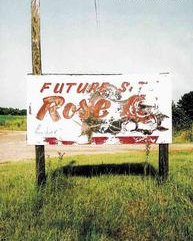
The other evening, Thursday the 13th to be precise, the Smithsonian, American Art Museum had a little shindig to celebrate its opening and the dual Christenberry exhibition (the folk art collection he curated and a retrospective of his own work: Passing Time).
I’ve gotten to know Christenberry a little through my work experience at Hemphill Fine Arts the past year and one of the many great things to come out of that acquaintanceship is a redefinition of two words within our lexicon: verbose and loquacious. At a speaking engagement in 2005, George Hemphill introduced Bill Christenberry as a loquacious Southern Gentleman. I had grown up thinking the word meant long winded in a sense where one loves to hear himself talk, whereas verbose just meant wordy. After Bill spoke that morning in mid-May he stepped in the offices of Hemphill and I said, “Bill, I don’t think your loquacious. Verbose maybe, but not Loquacious.” It was an off-hand compliment I thought he’d appreciate. However, being an older gentleman, he’s a little hard of hearing and the wit of the comment was lost.
Bill is a story-teller. There is a story behind every cabin he photographs, behind every dirt road he travels and behind every sign he picks up – some of those he freely admitted were stolen, though he thought “appropriated from their intended origin” had a better charm to their acquisition. And with that twist of vernacular I thought it best to redefine my previous notions of verbose and loquacious. Hemphill was on the money when he called Bill loquacious, because within that previous comment Bill Christenberry placed an eloquent touch on how he came to use the signs within his art work – an eloquence that was drawn out like the hot summer days he came to know in his Southern upbringing.
As a note, verbose I still think to mean wordy, only now I think of it as wordy without the eloquence. A problem my father and I tend to have when speaking freely and unable to edit, as within written texts (though admittedly, I may be a bit verbose in these epistles).
The two shows had a common theme through them – the care of the human hand in the act of visual expression. Through his curatorial work, Bill pulled from the permanent collection of SAAM some remarkably charming works of folk art that not only echoed the found nature of objects Bill had come to know through his own work, but also that sense of story, time, and place that is so evident through all of Bill Christenberry’s work. What tales may be told in a rifle that is bronzed and turned into a weather vane, or in a toy carved after Watergate with an elephant and a donkey on either side of a see saw. Wit and charm.
With rare exception, what the work in the Folk Art section of the museum does not possess is the building methodology of a man’s career with art. Throughout the last few decades Bill Christenberry has returned to locations in the South to photograph lots of land as their buildings age, become abandoned, overgrown and at times demolished and vacant. They exist like people, each with its own history. “Do you know the difference between a juke joint and a honkey tonk?” Bill asked me one afternoon as I visited his studio to collect some work and we go to talking about a Bar-Bah-Que shack in one of his building portrait pieces. Being from Iowa these were words I had heard, but never in any context. A juke joint sounded like a place where one might encounter a juke box. “That’s a good guess,” he suggested. “I’ll give you a clue,” he politely continued, “ a honkey tonk is where the honkeys went.”
Stories like that exist within each article exhibited in Passing Time. They compose the identity and curiosities of Bill Christenberry. They compose the identity of the South. However, knowing the volume of work Bill has produced throughout his career, like the identity of the South, this exhibition is but the tip of something much larger.
So the Renwick has a Wood
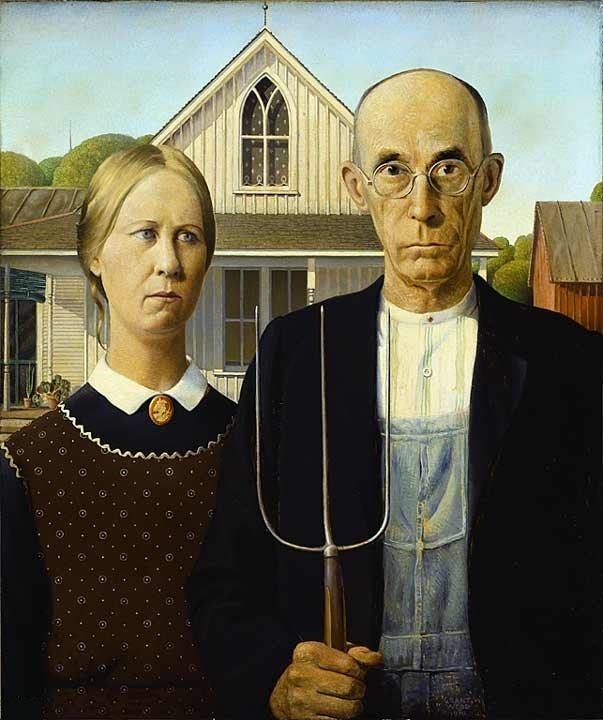
With the Renwick’s recent exhibition of Grant Wood I have had to tolerate people informing me they have seen the work once they learn I am from Iowa. But I refuse not to look bored if asked if I have seen it too. I won’t. It’s not because I don’t like Wood.
Hard to escape that damned “American Gothic” growing up. The Des Moines Art Museum and Art Institute of Chicago have a joint ownership of the piece, or at least some sort of loan agreement that allows the piece to travel between the two museums for periods of lengthy exhibit. The former Davenport Art Museum, the only fine arts museum in my home town, had a loan agreement with the two museums that captured the piece on it’s 310 mile journey for a three or four month display every five years. For the cost of a couple clams any person in the area could stop in, say hello to the farmer, compliment him on his lovely daughter, and be on his or her way.
Now, when people tell me how ironic the piece is, I tend to disagree. The irony is that this is the celebrated icon of regional American art, and about the best-known piece of Wood’s when so many other pieces he crafted in his short career were fare superior in complexity and wonder and capture the region of the vast American Midwest with better accuracy and articulation.
That quote of Ruscha comes to mind, and I’ll butcher it here. “There are parts in the middle of America that are every bit as surreal as Paris.”
Few from Iowa would ever claim Wood as “ironic.” I grew up in a time of Farm Aid, when various rock and country musicians would gather in some field and raise money for farm relief. During my childhood there were stories about farmers blowing their brains out because their generations-old family farm was facing foreclosure. In college, farmers were slaughtering large swaths of livestock because the bottom dropped out of the hog market and it was cheaper to kill them and let them rot than to try and butcher them and sell them at market. Then there are the droughts that claim hundreds of thousands of acres of corn, soy, and sorghum and the emergency aid requested by the state and national government.
Perhaps the irony comes from what else was being produced around the same time. Hopper was creating a lonely Eastern seaboard. Lawrence and Davis were making jagged forms of Manhattan urban life. Pollock was throwing paint. DeKooning was butchering women. Rockwell was illustrating the ideals of the American dream. Wood, and Hopper for that matter, can be looked upon as ironic sandwiched in the middle. Their form of representation was not idillic – though who educated in the arts looks at Rockwell as anything but what he claimed himself to be: an illustrator? Their use of paint was neither abstract nor expressionist. If anything is ironic, it was the choice to paint what he painted, and in the way he painted it. But that can only happen through the lens of art history.
Wednesday, July 05, 2006
I Wish This Was A Joke

While fully respecting the creation of this statue and finding it quite clever, though kitch, it is my sincere wish that the religious right would fully relaize the implications of the first part of the first amendment of our nation's Constitution.
Amendment I: Congress shall make no law respecting an establishment of religion, or prohibiting the free exercise thereof; or abridging the freedom of speech, or of the press; or the right of the people peaceably to assemble, and to petition the government for a redress of grievances.
The Declaration of Independence was written to remove the colonials from the tax structure and ecumenism of England. There were those who wanted to be Catholics, Lutherans, Puritains, Quakers, Calvinists, Menonites, etcetera. While I cannot speak for their personal views towards Jews or Muslims, or even an awareness of the Far Eastern religions, I'm willing to wager that having been prohibited for so long to worship as they pleased the authors of the Declaration may have seen some value in allowing citizens of the United States of America to practice religion as they saw fit.
The writing in the First Amendment far outweighs any document that might state "in the year of our lord," the significance of A.D. (now replaced by C.E. in the history books). The use of that phrase moreover reflects the religion of the authors of those documents written rather than the religion of the country, even if they were governmental documents. This is the narrow vision of mankind (a word forged before the women's sufrage movement).
Therefore, it is likely that a document such as the Treaty of Tripoli, written under Washington and signed under Adams in 1797, more appropriately reflects the atmopsphere of the United States, less than twenty years after the Declaration was signed. The treaty is notable for Article 11, which states, ""As the Government of the United States of America is not, in any sense, founded on the Christian religion; as it has in itself no character of enmity against the laws, religion, or tranquillity, of Mussulmen..."
The website hosting this statue declares that Jesus will liberate us from things like disease and poverty. And there is nothing wrong with putting faith in Jesus Christ. My uncle Paul once did it after suffering a multiple fracture of his leg. While his prayers to Jesus may have had some part in allowing the bones to settle in appropriate allignment - an allignment the doctor's thought impossible because the bones were so badly shattered aftger his fall down a trap door, ironically in a church - my uncle Paul was certainly wise enough to allow the doctor's to apply a cast to further the aid of medicine upon his wounded limb and not dumb enough to attempt to limp out of there on his desimated drumstick.
The statue, erected by World Overcomers Ministries is certain to raise some eyebrows over the next few days and weeks. It might even stand as a monument for the 2006 and potentially 2008 elections, raising the constituent cries supporting Brownback and Westmoreland. Until it becomes a relic of arcane American monumentality my overarching hope is that the large majority of the populous recognizes the value and meaning of the first amendment, and that the message of Christ is more important than his statements of diety.
Note: Mussulmen was how they refered to Muslims when the treaty of Tripoli was authored.
Monday, July 03, 2006
America on the Brink
Yesterday I assumed the role of John 3:16 for the US Department of Art and technology for the ongoing series America on the Brink: A Season In Hell. We traveled to Lynchburg, VA to witness the 50th anniversary of Jerry Falwell's Thomas Road Baptist Church and the accompanying festivities at Liberty University.
Our documentation began at Rubs, a biker bar in town, where we were able to interview Pastor Steve Diaz of Iron Horse Ministries about his mission to build a bridge between bikers and Christians, bringing bikers who accept jesus Christ into their hearts closer to the church, and bringin Christians closer to their fait by being able to accept bikers.
He then talked about the United States as a Christian nation, and unifying the United States under Christ.
At the rally, Thunder on the Mountain, at the Liberty University stadium, we watched the bikers circle the track, showing off their steally pride, rubber side down. they revved their engines and smiled with pride and the love of Christ. Before they took to the field I heard one of the choir members of teh Thomas Road Baptist Church remark with fear that the reserved seats she wanted to sit next to were reserved for the bikers. "I don't want to tangle with them. They scare me. Maybe if enough of us sit in their reserved seats they won't feel welcome to sit here."
We wandered the grounds scattered with signs supporting George Allen and voting 4 marriage between one man and one woman.
The field alongside the newly erected 1,000,000 square foot church had an *awe*some display of flags waving in the wind, one for each fallen soldier in Iraq, and resting in the morning shadow of a flag typically flown above a pancake house.
A separate interview with a casual bystander yielded the remark about the return to a Christian nation "as our founding fathers intended."
What does that mean?
If the US were to become a Christian Nation, does that mean all citizens have to accept Christ as their personal savior? Does it mean that all citizens must acknowledge the trinity? What happens to those who do not?
The evangelists express concern for those who will be "left behind." But how will the evangelists persuade those who do not believe? Will the non-believers be shunned? Turned away? Will they be persecuted for their lack of belief and prohibited from jobs, education, health care, or property? What are the consequences? And should all confess belief, what truth and value is there in forced attrition?
Based on the reaction of the woman afraid of Christian bikers, what will the dress code be? Will we be prohibited from long hair, torn jeans, t-shirts and dirty faces tanned by the sun, stained by the wind rushing by at 65, the crunch of asphalt, or the splat of a junebug?
Our documentation began at Rubs, a biker bar in town, where we were able to interview Pastor Steve Diaz of Iron Horse Ministries about his mission to build a bridge between bikers and Christians, bringing bikers who accept jesus Christ into their hearts closer to the church, and bringin Christians closer to their fait by being able to accept bikers.
He then talked about the United States as a Christian nation, and unifying the United States under Christ.
At the rally, Thunder on the Mountain, at the Liberty University stadium, we watched the bikers circle the track, showing off their steally pride, rubber side down. they revved their engines and smiled with pride and the love of Christ. Before they took to the field I heard one of the choir members of teh Thomas Road Baptist Church remark with fear that the reserved seats she wanted to sit next to were reserved for the bikers. "I don't want to tangle with them. They scare me. Maybe if enough of us sit in their reserved seats they won't feel welcome to sit here."
We wandered the grounds scattered with signs supporting George Allen and voting 4 marriage between one man and one woman.
The field alongside the newly erected 1,000,000 square foot church had an *awe*some display of flags waving in the wind, one for each fallen soldier in Iraq, and resting in the morning shadow of a flag typically flown above a pancake house.
A separate interview with a casual bystander yielded the remark about the return to a Christian nation "as our founding fathers intended."
What does that mean?
If the US were to become a Christian Nation, does that mean all citizens have to accept Christ as their personal savior? Does it mean that all citizens must acknowledge the trinity? What happens to those who do not?
The evangelists express concern for those who will be "left behind." But how will the evangelists persuade those who do not believe? Will the non-believers be shunned? Turned away? Will they be persecuted for their lack of belief and prohibited from jobs, education, health care, or property? What are the consequences? And should all confess belief, what truth and value is there in forced attrition?
Based on the reaction of the woman afraid of Christian bikers, what will the dress code be? Will we be prohibited from long hair, torn jeans, t-shirts and dirty faces tanned by the sun, stained by the wind rushing by at 65, the crunch of asphalt, or the splat of a junebug?
Saturday, July 01, 2006
An Inconvenient Truth
When I’ve been told that An Inconvenient Truth is a slide show presentation on environmental data… well, it’s only part true. An Inconvenient Truth is about a man on a mission. It is a mission far greater than becoming president. It is a mission to save the world.
An Inconvenient Truth is the documentary of a man giving a presentation on the results of data collected by environmental scientists over the last fifty years. The results are supported with some very convincing photographic documentation of recent natural disasters; arctic ice shelf collapses; and the dramatic recession and glaciers snow cap mountains as well as the disappearance of rivers and lakes. The film also explores the motivation of the man who gives the presentation
The man giving the presentation is Al Gore. So, it is natural that this film will also carry some political weight and bias. But the moment that is interjected into the connotative analysis of the film the point is missed.
First, let us call this film a documentary because of the time invested in learning the narrator’s motivation for learning about and lecturing on this issue. Though it is told from a first person perspective and does not investigate another point of view there isn’t another one to investigate when the film involves the following four points. I am Al Gore. I have lectured on global warming since the 1970s. Here is why I lecture on this issue around the world. Here are the facts I have gathered along the way.
Second, what can be assumed is that it will be labeled a piece of docuganda by pundits on the right. Docuganda is defined as propaganda disguised as documentary because the film intends to influence rather than inform. The softer term is advocacy documentary. If the audience member chooses not to see this film as the abbreviated chronicle of a man’s motivation to give this lecture, then it can easily be seen as advocacy documentary because it is first person, because it only presents one point of view, and because the information is succinctly distilled for cogent comprehension.
But, so what? What is he advocating? Here is an abbreviated list, which are paraphrased from the closing credits. Higher fuel emission standards. Cleaner energy policies. Using energy saving appliances. Recycling. Using alternative transportation like public transportation, walking or bicycling. Demanding green and renewable energy options. Writing your congressman to support greener technologies.
Are these bad things to be advocating? No. Does it mean some conscious decisions need to be made on many individual levels? Yes. Will these decisions be convenient? Perhaps you missed that clever title assigned to the film.
Why else will it get labeled docuganda? Because of some of the gentle stabs Gore takes at the current administration on their environmental policies. Additionally, calling it docuganda, attempts to discredit the message for fear that any potential popularity from the film and media attention of the film may generate a Gore ’08 Campaign. And this misses the point of the film. Gore has globe-trotted for the last five years lecturing on how our current dependence on fossil fuel is a direct cause in global warming. Five years. It’s worth a listen.
Edit:
there is some information to support Gore's claim in the film that ice sheets in Antarctica and Greenland are shrinking at drastic rates.
http://www.factcheck.org/article395.html
An Inconvenient Truth is the documentary of a man giving a presentation on the results of data collected by environmental scientists over the last fifty years. The results are supported with some very convincing photographic documentation of recent natural disasters; arctic ice shelf collapses; and the dramatic recession and glaciers snow cap mountains as well as the disappearance of rivers and lakes. The film also explores the motivation of the man who gives the presentation
The man giving the presentation is Al Gore. So, it is natural that this film will also carry some political weight and bias. But the moment that is interjected into the connotative analysis of the film the point is missed.
First, let us call this film a documentary because of the time invested in learning the narrator’s motivation for learning about and lecturing on this issue. Though it is told from a first person perspective and does not investigate another point of view there isn’t another one to investigate when the film involves the following four points. I am Al Gore. I have lectured on global warming since the 1970s. Here is why I lecture on this issue around the world. Here are the facts I have gathered along the way.
Second, what can be assumed is that it will be labeled a piece of docuganda by pundits on the right. Docuganda is defined as propaganda disguised as documentary because the film intends to influence rather than inform. The softer term is advocacy documentary. If the audience member chooses not to see this film as the abbreviated chronicle of a man’s motivation to give this lecture, then it can easily be seen as advocacy documentary because it is first person, because it only presents one point of view, and because the information is succinctly distilled for cogent comprehension.
But, so what? What is he advocating? Here is an abbreviated list, which are paraphrased from the closing credits. Higher fuel emission standards. Cleaner energy policies. Using energy saving appliances. Recycling. Using alternative transportation like public transportation, walking or bicycling. Demanding green and renewable energy options. Writing your congressman to support greener technologies.
Are these bad things to be advocating? No. Does it mean some conscious decisions need to be made on many individual levels? Yes. Will these decisions be convenient? Perhaps you missed that clever title assigned to the film.
Why else will it get labeled docuganda? Because of some of the gentle stabs Gore takes at the current administration on their environmental policies. Additionally, calling it docuganda, attempts to discredit the message for fear that any potential popularity from the film and media attention of the film may generate a Gore ’08 Campaign. And this misses the point of the film. Gore has globe-trotted for the last five years lecturing on how our current dependence on fossil fuel is a direct cause in global warming. Five years. It’s worth a listen.
Edit:
there is some information to support Gore's claim in the film that ice sheets in Antarctica and Greenland are shrinking at drastic rates.
http://www.factcheck.org/article395.html
Friday, June 30, 2006
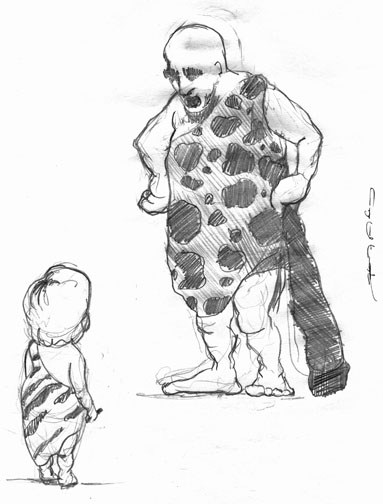
Friday, June 23, 2006
Satan?

Not often does the leviathan show himself. Captured here is beelzebozo, blind and grinning.
This capture is part of an ongoing project with the US Department of Art and Technology for the next installation of A Season in Hell. Whether this capture will be used in the final exhibit remains to be seen.
Rod Parsley, a dominionist pentecostal minister from Columbus, Ohio, has finished no theological training and is open about his disdain of formal Bible training. He believes that part of salvation is achieved through tithing and has pocketed much of the tithing of his 12,000 person congregation to purchase a private jet and to construct adjacent million dollar properties: one for his family and a second for his father. Parsley preaches against the "evils" of homosexuality, the separation of church and state, and Islam. He also provides the service of faith healer if the sum of cash is correct.
The false prophet is quite entertaining during his services. He preaches in voices. He struts and dances about. He mocks and ambles and jibes. His orchestra has the improvisational talents similar to that of Paul Schafer, accenting Parsley's skits and absurdities. And, when tithing, he reminds you how to spell thousands, enunciating each letter with exactitude.
Monday, June 19, 2006
Art Is Not Popular
...according to a graphic found in the text "Reporting for the Media." (by Fred Fendler, John R. Bender, Lucinda Davenport, and Michael W. Drager and published by Oxford University Press). The graphic indicates that the least popular news stories are "Business, Agriculture, Religion, Minor Crimes, State Government, Art, Music, Literature."
To be fair, this information was gleaned from the 7th edition, published in 2001. There is a good chance that Music and Literature are more popular stories to read than Art at the time of this post. And, thanks to the Neo Cons, I'll wager Religion has become more popular than Agriculture... unless we are discussing pork belly markets.
The graphic also indicates that the percentage of readers completing an article drops significantly as the number of paragraphs within a story increases. Five paragraphs maintains a readership of 56%, ten paragraphs maintains a readership of 39%, and twenty-five paragraphs maintains a readership of 28%. With this kind of statistic, it is safe to say that art blogs might have some sustaining power in the long haul provided we keep things short and sweet... unlike many of my previous posts.
To be fair, this information was gleaned from the 7th edition, published in 2001. There is a good chance that Music and Literature are more popular stories to read than Art at the time of this post. And, thanks to the Neo Cons, I'll wager Religion has become more popular than Agriculture... unless we are discussing pork belly markets.
The graphic also indicates that the percentage of readers completing an article drops significantly as the number of paragraphs within a story increases. Five paragraphs maintains a readership of 56%, ten paragraphs maintains a readership of 39%, and twenty-five paragraphs maintains a readership of 28%. With this kind of statistic, it is safe to say that art blogs might have some sustaining power in the long haul provided we keep things short and sweet... unlike many of my previous posts.
Monday, June 12, 2006

Monday, June 05, 2006
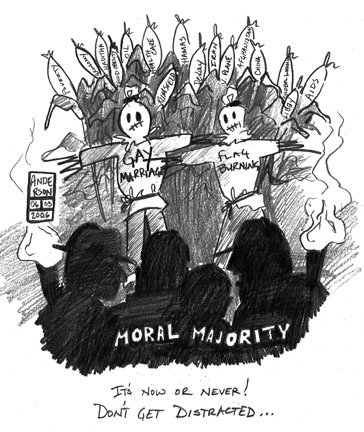
Wednesday, May 31, 2006
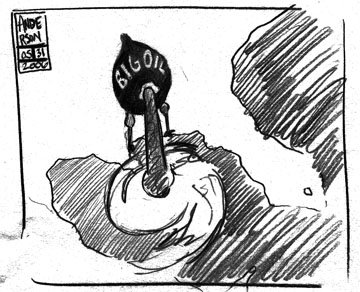
Tuesday, May 30, 2006
Ledelle Moe, Congregation: G-Fine Art
Normally I wouldn't think of a small head as something to be marveled at. Upwards of 500 in congregation with one another tends to have a more lasting effect. Especially when each is hand-carved in cement. Yet, individually, each head resonates something of the artifact, something precious yet sturdy.
So rarely does my jaw drop when walking into a space. [Sometimes it is due to an oversaturation of information, or utter banality of something argued as significant.] These heads were remarkable - turned, talking, reacting, engaged, the voices in a choir. It is this animation, this relationship they have with one another that gives them their strength and removes them from the sterile presentation akin to tribal masks on a wall.
Individually it is clear that the whole is different than the sum of its parts. Annie Gawlak was kind enough to remove one from the wall for me, to allow me to touch it and feel its weight. And, as I stood there contemplating this little creature, I thought how barren this would be isolated and alone on my wall, without friends to accompany it. Though monumental and terrific on its own, it becomes a VCR on pause, trapped in time and waiting to be activated once again. I returned the little head to Annie so that it could once again gain life through communion.
So rarely does my jaw drop when walking into a space. [Sometimes it is due to an oversaturation of information, or utter banality of something argued as significant.] These heads were remarkable - turned, talking, reacting, engaged, the voices in a choir. It is this animation, this relationship they have with one another that gives them their strength and removes them from the sterile presentation akin to tribal masks on a wall.
Individually it is clear that the whole is different than the sum of its parts. Annie Gawlak was kind enough to remove one from the wall for me, to allow me to touch it and feel its weight. And, as I stood there contemplating this little creature, I thought how barren this would be isolated and alone on my wall, without friends to accompany it. Though monumental and terrific on its own, it becomes a VCR on pause, trapped in time and waiting to be activated once again. I returned the little head to Annie so that it could once again gain life through communion.
Monday, May 22, 2006
Nakadate: Adamson Gallery
As I heard the words of Van Morrison’s Tupelo Honey in the background one phrase stood out as I made my way through Adamson Gallery exploring Laurel Nakadate’s recent work Trouble Ahead, Trouble Behind – “she’s got a wonderful sense of humor.”
That is also the limit of the work, on exhibition through June 3rd. The most interesting portion of this body (no pun intended) of work is contained in the first sentences of the press release and artist statement, wherein the artist embarked on a thirty day cross country train ride. The rest of the work can be summed up in well composed and designed photographs that attempt to be a little transgressive and yet remain impersonal, sterile, and narcissistic.
Placed in hotel rooms and the cabin of her train, Nakadate poses in her panties in the pseudo seductive poses found in Playboy. The sense of seduction becomes lost in the environment of polyester fabrics and overcast skies. When her gaze addresses the camera it never seems inviting or overly confrontational, but kind of bored. Color is muted and subdued leaving a mostly uninteresting photograph of a mostly naked woman in a mostly non-descript room.
And with this being the dominant theme of the show, there is work that rests out of place. The artist mostly naked on the back of a horse and the artist mostly naked somewhere in the desert come to mind. The color is rich, but the themes are out of place. Then there are the wonderfully graceful close-ups of the artist’s panties as they dangle from the window of her train (described in both artist statement and press-release). These are by far the strongest works on exhibit. They are elegant against the backdrop of a dreary sky. But the consistency of the overcast skies makes the narrative feel forced. Then there is the police car in the background of one photo, the looming threat of order and control, the push for transgression, and the inconsistency of thesis.
Qualms can be raised about the video as well. Her dance on the porch of the home from American Gothic is witty – a strip tease dance without the strip-tease on the unrequited reflexive emblem of American innocence. Then the song changes along with the video: artist seated in the cabin of her train, eyes searching the horizon wildly for a passing pick-up truck so that she can flash her tits mischievously and giggle, only to scope the horizon again.
What is apparent is the utter senselessness this work has. There is no goal within the work, no sense of discovery, no sense of the country, no sense of self and - dare I say - no sense of art. Any argument about sexuality or the female gaze become pointless in the face of this work – it isn’t there! It doesn’t even try to be shocking for the sake of being shocking (except maybe the sticker price of the work). It is the documentation of a wasted cross-country trip and abandoned underwea
That is also the limit of the work, on exhibition through June 3rd. The most interesting portion of this body (no pun intended) of work is contained in the first sentences of the press release and artist statement, wherein the artist embarked on a thirty day cross country train ride. The rest of the work can be summed up in well composed and designed photographs that attempt to be a little transgressive and yet remain impersonal, sterile, and narcissistic.
Placed in hotel rooms and the cabin of her train, Nakadate poses in her panties in the pseudo seductive poses found in Playboy. The sense of seduction becomes lost in the environment of polyester fabrics and overcast skies. When her gaze addresses the camera it never seems inviting or overly confrontational, but kind of bored. Color is muted and subdued leaving a mostly uninteresting photograph of a mostly naked woman in a mostly non-descript room.
And with this being the dominant theme of the show, there is work that rests out of place. The artist mostly naked on the back of a horse and the artist mostly naked somewhere in the desert come to mind. The color is rich, but the themes are out of place. Then there are the wonderfully graceful close-ups of the artist’s panties as they dangle from the window of her train (described in both artist statement and press-release). These are by far the strongest works on exhibit. They are elegant against the backdrop of a dreary sky. But the consistency of the overcast skies makes the narrative feel forced. Then there is the police car in the background of one photo, the looming threat of order and control, the push for transgression, and the inconsistency of thesis.
Qualms can be raised about the video as well. Her dance on the porch of the home from American Gothic is witty – a strip tease dance without the strip-tease on the unrequited reflexive emblem of American innocence. Then the song changes along with the video: artist seated in the cabin of her train, eyes searching the horizon wildly for a passing pick-up truck so that she can flash her tits mischievously and giggle, only to scope the horizon again.
What is apparent is the utter senselessness this work has. There is no goal within the work, no sense of discovery, no sense of the country, no sense of self and - dare I say - no sense of art. Any argument about sexuality or the female gaze become pointless in the face of this work – it isn’t there! It doesn’t even try to be shocking for the sake of being shocking (except maybe the sticker price of the work). It is the documentation of a wasted cross-country trip and abandoned underwea
Subscribe to:
Posts (Atom)

 Posts
Posts

