Saturday, February 10, 2007
Devil's Advocate
I produced this piece in 2005 during the sensationalism surrounding Terri Schiavo and I tried to comprehend both sides of the argument as best as I could. My grandfather was dying at the time - a drawn out fight with bone cancer - and this was the last piece of art he saw prior to his passing... unless you count Lawrence Welk.

Friday, February 02, 2007
Obamania!
 Unfortunately I'll be missing Wait-Wait Don't Tell Me for the next several weeks. Joe Biden... God Bless Him.
Tuesday, January 30, 2007
Round and Round
With crossed fingers, a grant from DCCAH, and assistance from a school of architects in Charlotte, NC I am hoping to embark upon the construction of a few receptacles for the second installment of Gestalt, which will cover the event Multimediale. I have been trying to ascertain from whom I should ask for a permit from the city government so I can place these "vending machines" in the public sphere.
I called Surface Permits and they directed me to Jose Colon. However, Mr. Colon tells me he deals with driveways and retaining walls. He told me to call Sam Williams who deals with special events and vending for the Department of Consumer Regulatory Affairs. He's a little tough to get a hold of, so I dialed his assistant, Curtis Wise who deals specifically with vending. He told me to call the Department of Transportation for permission.
This afternoon I called DC DOT and spoke with Bill. He told me the person I need to speak with is Jose Colon...
I called Surface Permits and they directed me to Jose Colon. However, Mr. Colon tells me he deals with driveways and retaining walls. He told me to call Sam Williams who deals with special events and vending for the Department of Consumer Regulatory Affairs. He's a little tough to get a hold of, so I dialed his assistant, Curtis Wise who deals specifically with vending. He told me to call the Department of Transportation for permission.
This afternoon I called DC DOT and spoke with Bill. He told me the person I need to speak with is Jose Colon...
Saturday, January 27, 2007
Rhyolite
 I'd never been to California or Nevada before the beginning of the month. And while I'll shy away from those reflections of the world's fifth largest economy, for now, I will state one thing about about Nevada. There are a lot of bored people there. Evidence - every road sign we crossed had been pock-marked by buckshot and the shoulders are paved with a menagerie of broken bottles.
 Rhyolite served as a mining town at the beginning of the last century. The town bloomed to about 10,000 around 1905, and by 1910 it was a memory. The mines bore less fruit than were hoped, the people packed up and moved on. Few houses remain. Oddly one new house existed, with paint and furniture that was held ransome by the hope of housing a tour guide for this region of decaying shelter.
Saturday, January 13, 2007
Hot off the Press

Late this morning I took a drive into Maryland to begin working with printmaker Katja Oxman on a new edition of a print she had been working on. This was my first experience as her press assistant.
The last exhibition of her work I saw was in 2005 at the Chautauqua Center for the Visual Arts, where I was working for the summer (she has exhibited several times since). The gallery director, Tom Ranesses, had been a student of hers at American University and had been her press assistant on and off since the mid 1980s. The show was a mix of her prints and her husband, Mark’s, sculpture. For the better part of a year I had familiarized myself with what Katja’s work looked like on the catalogue hanging from Mark’s sculpture studio door when I was his TA during my third semester of graduate study at American, but never had I seen one in person. Then I got to install what ostensibly could be considered a retrospective (of sorts).
Katja generally completes between two and three prints in a year (size depending) and as a result the work has not changed a great deal in the last thirty years: aquatints of still life consisting of ornate carpets, museum postcards, and jewelry boxes – keepsakes if you will. Evolution within the work has consisted of the addition of insects, plants, and most recently windows. There are also variations in size and compositions involving diptychs and triptychs. After working in the studio with her today, running three prints through the press, I can see why the change has been slight and gradual.
The process of printing the piece (for example the work above) consists of inking three plates - yellow, red, and blue (the above would take nine, three for each section). This also creates an isssue of registration so all three plates align. Where wiping the plates is concerned, the copper plates can be handled much more aggressively than a zinc-alloy plate I first worked on in graduate school - copper is more forgiving and flexible. Though, this still does not give credence to rush through the process. One print took me around 45 minutes to (help) create. Maybe it’ll get faster in the coming weeks as I continue to assist her on the press to the point where accomplishing five to six in my three to four hour window of time seems possible.
What is truly certain is how enjoyable it is to be in a print studio again: watching the ink bead and roll across the surface of the plate as the ink is applied; the texture of the tarlatan in hand to wipe the plate; the reveal of the plate as the ink is removed and the luster of it returns to the surface; the give of the press as the plate rolls along the bed. I may quickly tire of the repetition in several months, but the return is welcoming.
Thursday, November 30, 2006
Corcoran: Faculty Exhibition II
This evening’s opening at the Corcoran’s Second Installment of Faculty Work was interesting. It served as a good opportunity to view the work of many of my colleagues I teach alongside – only a couple of them I have met.
What I wanted to really engage was the public response to a work that I do not think would otherwise be accepted into any of the calls for entry that I could participate. The documentation of Note 2 Self made its debut this evening, along with the opportunity for individuals to participate, and many people were.
Earlier this week I bumped into Mark Cameron Boyd at the Katzen, reworking his installation outside the museum. He currently has three of his chalkboards available for people to fill in. And some have in rather obscene ways. We talked about that briefly and he mentioned how he has to accept that some people are going to interpret his work differently than his intentions, and if he is inviting people to contribute to the piece he has to except and accept that. This is the polite and academic way to state that there are those who will vandalize.
So, I was not surprised to see someone write “imposter” on a Post-It, or to actually write on the wall. Such defiance I was expecting. People were defiant the first time this was exhibited in a bus stop in late March. As for the imposter, I might have egged that on.
This piece I naturally assumed would have a relationship to Frank Warren’s Post Secret for two reasons: the public participation of personal/private (though innocuous) information, and because the material – a Post-It Note – has a relationship to the first word in Warren’s title. Anticipating that, and in a lousy hope to avoid that I have prefaced both the installation and the documentation by requesting that not be what is added in my piece. In fact, this time I explicitly requested participants to reserve all secrets for Warren’s piece.
HISTORY -- Note 2 Self was a piece conceived a little over one year ago waiting to commute to work when I was considering all of the chores I had to get done in the gallery, and what was left undone at home. And, judging the way people stared off into space waiting around me, I figured I wasn’t the only one. Even when my nose was in a book I was thinking but things to get done.
The Post-It Note has been a regular convention of my upbringing, and from the age of seven I remember that was how we communicated with one another about phone messages, groceries to get, and if I was going to the park to play basketball. (It’s only coincidence that my cousin art is one of the inventors; I’ve never met him to my knowledge, but I am told he is rather pleasant and humble.) I wanted to cover that bus stop in Post-It Notes, but hadn’t figured out how.
Fast forward nearly two months and I saw Frank Warren’s brilliant project in the old Georgetown Staples. I’d heard about it on Kojo, I’d been sent the link by a friend, and I even recalled the article in the Post. What I did not do was think about my little piece. Sometime later I thought there could be a relationship between the two, it is plausible that all the media attention of Warren’s work had primed my consciousness to conceive this piece, and I was willing to credit that plausibility. But, Post Secret starts with what is a seemingly profound and private secret and turns it into something more universal. I’m beginning with the universal and the banal, but highlighting the monumentality of an act of disposable authorship. Post cards we keep, and Warren publishes on a blog and in a couple of books. Post It Notes lay to waste in litter baskets and city dumps. Both contain something written and important. Both are organisms and public spectacles.
For a moment I had a bit of injured pride when I read the word “imposter.” But there is something empowering about that. I have inspired someone to publicly, and anonymously, heckle my work in an effort to humiliate me. When all is said and done that Post-It Note will be framed alongside the Post-It from the original installation – the Post It Note also anonymously authored that says “I love this piece.”
What I wanted to really engage was the public response to a work that I do not think would otherwise be accepted into any of the calls for entry that I could participate. The documentation of Note 2 Self made its debut this evening, along with the opportunity for individuals to participate, and many people were.
Earlier this week I bumped into Mark Cameron Boyd at the Katzen, reworking his installation outside the museum. He currently has three of his chalkboards available for people to fill in. And some have in rather obscene ways. We talked about that briefly and he mentioned how he has to accept that some people are going to interpret his work differently than his intentions, and if he is inviting people to contribute to the piece he has to except and accept that. This is the polite and academic way to state that there are those who will vandalize.
So, I was not surprised to see someone write “imposter” on a Post-It, or to actually write on the wall. Such defiance I was expecting. People were defiant the first time this was exhibited in a bus stop in late March. As for the imposter, I might have egged that on.
This piece I naturally assumed would have a relationship to Frank Warren’s Post Secret for two reasons: the public participation of personal/private (though innocuous) information, and because the material – a Post-It Note – has a relationship to the first word in Warren’s title. Anticipating that, and in a lousy hope to avoid that I have prefaced both the installation and the documentation by requesting that not be what is added in my piece. In fact, this time I explicitly requested participants to reserve all secrets for Warren’s piece.
HISTORY -- Note 2 Self was a piece conceived a little over one year ago waiting to commute to work when I was considering all of the chores I had to get done in the gallery, and what was left undone at home. And, judging the way people stared off into space waiting around me, I figured I wasn’t the only one. Even when my nose was in a book I was thinking but things to get done.
The Post-It Note has been a regular convention of my upbringing, and from the age of seven I remember that was how we communicated with one another about phone messages, groceries to get, and if I was going to the park to play basketball. (It’s only coincidence that my cousin art is one of the inventors; I’ve never met him to my knowledge, but I am told he is rather pleasant and humble.) I wanted to cover that bus stop in Post-It Notes, but hadn’t figured out how.
Fast forward nearly two months and I saw Frank Warren’s brilliant project in the old Georgetown Staples. I’d heard about it on Kojo, I’d been sent the link by a friend, and I even recalled the article in the Post. What I did not do was think about my little piece. Sometime later I thought there could be a relationship between the two, it is plausible that all the media attention of Warren’s work had primed my consciousness to conceive this piece, and I was willing to credit that plausibility. But, Post Secret starts with what is a seemingly profound and private secret and turns it into something more universal. I’m beginning with the universal and the banal, but highlighting the monumentality of an act of disposable authorship. Post cards we keep, and Warren publishes on a blog and in a couple of books. Post It Notes lay to waste in litter baskets and city dumps. Both contain something written and important. Both are organisms and public spectacles.
For a moment I had a bit of injured pride when I read the word “imposter.” But there is something empowering about that. I have inspired someone to publicly, and anonymously, heckle my work in an effort to humiliate me. When all is said and done that Post-It Note will be framed alongside the Post-It from the original installation – the Post It Note also anonymously authored that says “I love this piece.”
Wednesday, November 29, 2006
Caution: Rhetoric Ahead - SIlver Wings
I had the spare time to make it down to the Corcoran this evening for the third installation of the new and experimental media series juried by Paul Roth and Peggy Parsons this evening, and I am rather thankful I did. Granted, few if any of the pieces chosen really challenged new and experimental media that had not already been laid in the foundations we can collectively call the 1960s, but this does not mean the vivid and sometimes wonderful abstractions of film were not worth watching. Quite the contrary: I enjoyed nearly all the videos. Granted, I have a new-found fear of pigeons, and a pang of curiosity why Gene Kelly was juxtaposed with Bobby Kennedy, but if you weren’t there, I’m not going to go into detail.
There were two flaws with the production of the evening. The first was the obvious problem of failing media. Two discs failed, which, while shortening the length of the evening by 20 minutes was acceptable, watching the struggle was not. Compounded by the stop, play and reading of discs, it should be ne3cessary for the WPA/Corcoran to realize that they need to consolidate all media onto one disc, submission into the exhibition is consent by the artist for this to occur. Since this is series is in its beginnings, this flaw is quite forgivable. Five years from now, people might still overlook it, but only with chagrin.
Flaw two has a relationship to a Frank Lloyd Wright criticism of architecture of the early industrial age recapitulating architecture of antiquity and the ancients. Consider: if film is an extension of theatre, erecting the fourth wall to distance the actor from the audience, why are we exposed only to movies in an experimental media series. There was little experimental with tonight’s work. Overlapped film/video goes back to (S) Einstein… maybe further. The combination of live music and video in psychedelic tones (even if it is T2 and Total Recall mashed and symmetrical) invokes The Velvet Underground at the Factory. Meditations on film projectors, dancing Egyptian girls at a wedding, or Monarch butterflies migrating, even with funky Final Cut and After Effects tweaks, does not inspire anything more than a film of a man sleeping or of clouds passing the Empire State Building. Pigeons in slow motion… hi, Bill Viola! I take nothing away from the artists on exhibit this evening, but I want to punctuate one thing: there was nothing experimental… except maybe to the artists… and some of the people watching. If I throw paint on the canvas I am experimenting. But Pollock has already done it, and hundreds of thousands of others since.
I also object to the label of new media for this series. Media represents the display of several medium(s). This was new video, and only new in the same sense that Déjà Vu or Deck the Halls is new, and even then only kinda. Let’s be willing to call a spade a spade.
There were two flaws with the production of the evening. The first was the obvious problem of failing media. Two discs failed, which, while shortening the length of the evening by 20 minutes was acceptable, watching the struggle was not. Compounded by the stop, play and reading of discs, it should be ne3cessary for the WPA/Corcoran to realize that they need to consolidate all media onto one disc, submission into the exhibition is consent by the artist for this to occur. Since this is series is in its beginnings, this flaw is quite forgivable. Five years from now, people might still overlook it, but only with chagrin.
Flaw two has a relationship to a Frank Lloyd Wright criticism of architecture of the early industrial age recapitulating architecture of antiquity and the ancients. Consider: if film is an extension of theatre, erecting the fourth wall to distance the actor from the audience, why are we exposed only to movies in an experimental media series. There was little experimental with tonight’s work. Overlapped film/video goes back to (S) Einstein… maybe further. The combination of live music and video in psychedelic tones (even if it is T2 and Total Recall mashed and symmetrical) invokes The Velvet Underground at the Factory. Meditations on film projectors, dancing Egyptian girls at a wedding, or Monarch butterflies migrating, even with funky Final Cut and After Effects tweaks, does not inspire anything more than a film of a man sleeping or of clouds passing the Empire State Building. Pigeons in slow motion… hi, Bill Viola! I take nothing away from the artists on exhibit this evening, but I want to punctuate one thing: there was nothing experimental… except maybe to the artists… and some of the people watching. If I throw paint on the canvas I am experimenting. But Pollock has already done it, and hundreds of thousands of others since.
I also object to the label of new media for this series. Media represents the display of several medium(s). This was new video, and only new in the same sense that Déjà Vu or Deck the Halls is new, and even then only kinda. Let’s be willing to call a spade a spade.
Saturday, November 18, 2006
An Open Letter to Claudia Rousseau
I am writing this with the full intent of explaining a question that Claudia Rousseau raised within her review of the current exhibition at Glenview Mansion Art Gallery, which contains an installation of mine. In her article in the Rockville Gazette, she mentioned how surprised she was to see that in neither my artist statement nor my newspaper did I give any mention or credit to Mimmo Rotella. For this there are several good explanations to dissuade such conjecture.
The first is an issue of avoidance. Not so much skirting the work of others for the sake to appear original, but more for the sake of not watching people’s eyes glaze over. The learned artist, critic, gallerist, or historian, interested in contemporary art and with a wide knowledge of Pop-like movements that occurred across the pond, might know the name of Mimmo Rotella. He is/was well-known in Italy since the mid to late 1950s in and outside of the art circles. But, for a pedestrian, American audience that might scarcely know the name of Tom Wesselman or James Rosenquist (and there are many… don’t kid yourselves oh learned minority, because three years ago I was a member of that audience), Mimmo Rotella first requires a double take to first discern the pronunciation and then a definition to follow.
The second issue can be summarized by the early career of Jacques Villegle. To define: Rotella and Villegle both veered into collage and decollage about the same time in the late 1950s. Because Villegle was in Paris and Rotella in Rome, neither knew well of the other’s interest of this method of working at first – which, to be specific and simple, involved ripping down full street posters and gluing them to canvases. Forty plus years later I came to Rome for a second time, knew nothing of the work of either man, and began tearing down whole stinking and bug infested posters only to dissect them like an archaeologist so I could reassemble them through means I thought might be more archival or at least solvent. I was thinking of Schwitters, and the street was my dustbin. Then, these collages became studies for paintings.
Now, I can’t fault my art history teacher, Terry Kirk*, for setting foot in the studios for the first time AT THE END of the semester, AT THE END of my first year of graduate school, to inform me of Mimmo Rotella’s work when I was studying in Rome. Nor can I justify his incredulity toward my ignorance of the man. All I can say is sorry. The state of Iowa kind of stops at Grant Wood in public art school education. Ana Mendieta doesn’t even get a nod (or club OJ candidate Carl Andre, for that matter).
I returned to the States to complete my second year of graduate study, which is an additional hamstring. Finding scholarship on either Rotella or Villegle is difficult, let alone one in a language I can read. And, to be faithful to my initial inclinations of interest in those smelly posters, it was the halftone, color, typography, and play between representational and abstract that were of greater interests. Process became a second, because it played as a rich analogy for the history of Rome and Roman architecture: built up over time, stripped away by vandals, and built up again. Only in the States did I begin thinking about new narratives and the meaning of the words, critique on culture, economy, or politics. And the only reason I can think it took so damn long is because I was forced into an environment with adequate ventilation where I wasn’t huffing turps for a couple months.
In short, Rotella is incidental. So is Villegle. Two guys I’d never heard of before, on a continent that isn’t mine, speaking languages I can scarcely speak, doing work that is a novelty to this Midwesterner. After all, there aren’t a lot of posters plastered in the cornfields (though I am certain Monsanto has thought of it) – just baseball diamonds. Be that as it may, even with my recent scholarship, he still remains incidental. His work, as he has stated, was a rebellion, “…the only way of protesting against a society that has lost the taste for change and fantastic transformations.” (Hentschel; Mimmo Rotella) On the other hand, I don’t have much rebellion in me, just sarcasm.
Rotella’s work now remains as a document, a record, an archive, an objet d’arte, instead of a painting (not painted). I can nod to him as someone who has done similar work. But I hope to take it somewhere different. That stated, I am certain there are tens of people who have done likewise before me. I’ll never know of it – I’ll probably never meet them – and it doesn’t invalidate my work anymore than Caravaggio invalidates de la Tour (despite the difference that what I’ve done is mostly a priori).
So, that’s why I don’t mention Rotella. Because it takes me seven paragraphs (not including this one), and eight hundred words to do so. And that is without going into the sordid history of growing up in a test-market, studying graphic design, mentioning Hannah Hoch, and on, and on, and on. The end.
*note: Terry Kirk is still the best damn and most entertaining art history professor I have had the pleasure to learn from and in his defense he had too much on his plate that semester in Rome. And, no, that link was not a picture of John Waters
The first is an issue of avoidance. Not so much skirting the work of others for the sake to appear original, but more for the sake of not watching people’s eyes glaze over. The learned artist, critic, gallerist, or historian, interested in contemporary art and with a wide knowledge of Pop-like movements that occurred across the pond, might know the name of Mimmo Rotella. He is/was well-known in Italy since the mid to late 1950s in and outside of the art circles. But, for a pedestrian, American audience that might scarcely know the name of Tom Wesselman or James Rosenquist (and there are many… don’t kid yourselves oh learned minority, because three years ago I was a member of that audience), Mimmo Rotella first requires a double take to first discern the pronunciation and then a definition to follow.
The second issue can be summarized by the early career of Jacques Villegle. To define: Rotella and Villegle both veered into collage and decollage about the same time in the late 1950s. Because Villegle was in Paris and Rotella in Rome, neither knew well of the other’s interest of this method of working at first – which, to be specific and simple, involved ripping down full street posters and gluing them to canvases. Forty plus years later I came to Rome for a second time, knew nothing of the work of either man, and began tearing down whole stinking and bug infested posters only to dissect them like an archaeologist so I could reassemble them through means I thought might be more archival or at least solvent. I was thinking of Schwitters, and the street was my dustbin. Then, these collages became studies for paintings.
Now, I can’t fault my art history teacher, Terry Kirk*, for setting foot in the studios for the first time AT THE END of the semester, AT THE END of my first year of graduate school, to inform me of Mimmo Rotella’s work when I was studying in Rome. Nor can I justify his incredulity toward my ignorance of the man. All I can say is sorry. The state of Iowa kind of stops at Grant Wood in public art school education. Ana Mendieta doesn’t even get a nod (or club OJ candidate Carl Andre, for that matter).
I returned to the States to complete my second year of graduate study, which is an additional hamstring. Finding scholarship on either Rotella or Villegle is difficult, let alone one in a language I can read. And, to be faithful to my initial inclinations of interest in those smelly posters, it was the halftone, color, typography, and play between representational and abstract that were of greater interests. Process became a second, because it played as a rich analogy for the history of Rome and Roman architecture: built up over time, stripped away by vandals, and built up again. Only in the States did I begin thinking about new narratives and the meaning of the words, critique on culture, economy, or politics. And the only reason I can think it took so damn long is because I was forced into an environment with adequate ventilation where I wasn’t huffing turps for a couple months.
In short, Rotella is incidental. So is Villegle. Two guys I’d never heard of before, on a continent that isn’t mine, speaking languages I can scarcely speak, doing work that is a novelty to this Midwesterner. After all, there aren’t a lot of posters plastered in the cornfields (though I am certain Monsanto has thought of it) – just baseball diamonds. Be that as it may, even with my recent scholarship, he still remains incidental. His work, as he has stated, was a rebellion, “…the only way of protesting against a society that has lost the taste for change and fantastic transformations.” (Hentschel; Mimmo Rotella) On the other hand, I don’t have much rebellion in me, just sarcasm.
Rotella’s work now remains as a document, a record, an archive, an objet d’arte, instead of a painting (not painted). I can nod to him as someone who has done similar work. But I hope to take it somewhere different. That stated, I am certain there are tens of people who have done likewise before me. I’ll never know of it – I’ll probably never meet them – and it doesn’t invalidate my work anymore than Caravaggio invalidates de la Tour (despite the difference that what I’ve done is mostly a priori).
So, that’s why I don’t mention Rotella. Because it takes me seven paragraphs (not including this one), and eight hundred words to do so. And that is without going into the sordid history of growing up in a test-market, studying graphic design, mentioning Hannah Hoch, and on, and on, and on. The end.
*note: Terry Kirk is still the best damn and most entertaining art history professor I have had the pleasure to learn from and in his defense he had too much on his plate that semester in Rome. And, no, that link was not a picture of John Waters
Friday, November 17, 2006
Website Up
In the past week I have been tweaking a design for a website and it is finally up. Granted, it is hosted by American University, so please forgive me for not boring you with a long title. For the mean time, this will be my website
Meanwhile, the following is a link to a recent review of the work at Glenview Mansion. Which means I'll need to update the bibliography on my resume and repost it to my website. Management...
Meanwhile, the following is a link to a recent review of the work at Glenview Mansion. Which means I'll need to update the bibliography on my resume and repost it to my website. Management...
A Conversation with Alice
The following entry, a conversation with Alice Denney, is taken from the first issue of Gestalt, published shortly before the first of November. Copies can be found at the Glenview Mansion Art Gallery and DCCAH.
----------------------------------------------------------------------------
Discussing ideas on how to bolster the arts scene in Washington, DC through collaboration and the exhibition of multi-media seemed an appropriate subject with Alice Denney. She has seen it all, and her influence would only require a glimpse through her CV. In 1958 she opened The Jefferson Place Gallery. In 1962 she was instrumental with the opening of the Museum of Modern Art in DC. She took a leave of absence from the museum to work as the United States Vice Commissioner for the Venice Biennale under Alan Solomon in 1964. There were the happenings she organized in the mid 1960s with Rauschenberg and Cage and Oldenberg. Finally there was her stint with the WPA between 1975, when she helped found the organization, until her “retirement” in 1980.
The conversation, however, focused less on collaboration and multi-media, and more on the challenges of the greater Washington arts scene as she has experienced and observed. Five recurrent themes were expressed.
1. More venues for experimental arts.
“Galleries are important. But they need to take chances!” Alice Denney understood that from the moment she opened The Jefferson Place Gallery. In 1958 she opened the gallery with the express interest of providing artists in Washington a venue to exhibit the work they wanted to exhibit. She exhibited artists from American University - Ben Summerford and Robert Gates - as well as the DC colorists like Kenneth Noland. The differences in styles were evident as were their differences in where painting should go next. In order to advance the ideas of art and how art functions, a gallery must be willing to take chances for the sake of the artists. Ironically in order for a gallery to stay in business it must sell those chances to a buyer. She observed the many exhibitions of her good friend Annie Gawlik at G-Fine Art and recognized Annie's exhibitions as some of the gutsiest. Alice then pointed across her living room to a Luis Silva toadstool, “that show got no attention. A lot of Annie's shows don't get any attention. Luis's exhibition was genius! It was exactly the sort of thing DC needs more of. But, who wrote about it? Working in galleries is tough business.”
Observing the model of the 14th street, where in a given hour a person can observe the work in Transformer, Irvine, G, Adamson, and Hemphill. “At the very least there needs to be some sort of core for experimental and emerging arts. If The WPA, and Transformer and The Warehouse Gallery and a couple of other galleries were to get together you would have a center. One space. So that you know when you are going there you have something new and exciting (to see). And it can be a learning process, so that when people are curious it doesn't have to take so much time (driving from place to place).”
2. Nurture an audience interested not just in collecting, but also learning about the work.
It was this idea, learning about the art, that Alice continually emphasized about her experiences. “There was an audience who wanted to learn. That was the interesting thing. It wasn't Bohemian. In my day there were crowds of people who went around to the gallery openings. Oldenburg had his group. Andy (Warhol) had his group. And it was the groups that would flow between the scenes. Now it's just a mob,” This kind of mob is sometimes observed at most openings where the audience is mixed between the willing acolytes, the mad collectors, and the people who are simply there to be seen in rhinestone studded designer Yankees t-shirts sipping white wine.
“You have to understand, I've never been a collector.” She said. “I mean, sure, I bought a couple of pieces.” She pointed to her paintings and sculpture. “But I think of this like my scrap board. I mean, I wasn't a saint about it, but it helped those artists out. They were young and no one knew who they were. But, I was also interested in their work!” Collectors she defined as the people who would harass Leo Castelli and insistent that they would do anything to buy the next Jasper Johns, to pay any price above the other collectors situated on the list, also demanding the same attention.
3. Criticism.
“There is nobody who is reviewing the work (in print), just a little bit. Artists need critical feedback to know that, 'well, maybe this isn't working.'” This has been the biggest criticism on the blogosphere, of late, and judging by Alice's comments, perhaps the largest criticism before the internet. DC possesses no constant printed criticism, as was pointed out in a December 20, 2005 posting on Lenny Campello's dcartnews.blogspot.com. He pointed out that, in a given month, the Washington Post might have four articles critiquing the art around DC, and that The Arts section of The Post is inappropriately named. For example, sometime after the interview with Alice, pop celebrity Ashton Kutcher's transformation, from little-screen bozo to big-screen action star, recently graced the front of the Arts section. Being neither from Washington, nor an artist, this observation epitomizes the commentaries by Campello and Ms. Denney. “DC has never had an arts writer. Gopnik is trying to report on world-class art in London. Who really cares about art in London? Who here is going to go see it? Richards was pulled from the sports section. Jessica Dawson is taking art classes to learn more about it. So at least she is trying!”
It was that effort she appreciated most. In the hey-day of Alice Denney, when she was bringing experimental theatre to Washington, DC there was one critic who got it. A critic for DC must have the flexibility to understand and critique not only the popular but the experimental theatre, dance, the plastic arts, and multi media as well as the courage to say what is or is not working and why.
4. Politicians need to stay in politics.
When a politician, politician's spouse, or potential judicial nominee to the higher courts gets on the boards of arts organizations, more often will they make decisions that do less damage to their careers. “Politicians aren't real,” she said. “They have to appeal to a constituency back home so they can get re-elected.” Art has taken much the same route. She described an incident from the early days of the Museum of Modern Art in DC, wherein a Tom Wesselman All-American Nude was rejected from an exhibition, at the insistence of a member of the museum board - the wife of a senator from Pennsylvania - because the likeness of Jack Kennedy was also in the painting. “Almost all of the Pop Artists were willing to pull their work out in support of Tom,” she finished.
Alice cited the Mapplethorpe Show as another example. “The Corcoran never would have had a problem with the Mapplethorpe exhibition.” The irony of the Mapplethorpe exhibition is in the many years that have followed, the show has had a near legendary infamy more for the fact that the Corcoran chose not to exhibit the work rather than the content of the work. After the Corcoran dropped the show, the WPA picked it up after Alice prodded the board. “It turned out to be one of the best shows at the WPA! Granted, everyone was nervous with the reputation that was built up over the thing, and they decided to place the most sensitive work in one room. But, that room was packed! That's where everyone wanted to go!”
5. Koons = Bad Porn.
“I hate to sound terrible. I feel like I've seen it all. Even multi-media. That doesn't move me. It seems so mechanical. It seems easy. I watched those artists (in the 1960s) struggle using such rudimentary materials. And the beauty that came out was just spectacular. When we were doing happenings we were doing them on tennis courts and skating rinks. Our equipment was not that sophisticated.” She gestured approximating the volume of a reel-to-reel projector with her hands. “We'd show this (equipment) to the audience and they'd laugh! But then we would show this beautiful performance. When I see some of the video things (today), it just goes back to old Andy Warhol. (It was interesting) then because he was in the groove; it was the first time.”
Amid the rinse and repeat of some forms of art since the beginning of the 1970s, Denney mentioned the work of Hirst and Koons who were polluting the environment. “(Koons) was selling stocks before he got into art. All he did was know how to market and publicize himself. Even his version of pornography was bad porn.”
Sadly, Koons's and Hirst's versions of art are not reflections of art or culture, but of a market that caters to collectors and the idea that art is more about shock and awe and less about an intelligent and sometimes emotional perceptual cognition. But if there is safety in numbers, then it is groups of artists who can collaborate and spearhead these five initiatives.
----------------------------------------------------------------------------
Discussing ideas on how to bolster the arts scene in Washington, DC through collaboration and the exhibition of multi-media seemed an appropriate subject with Alice Denney. She has seen it all, and her influence would only require a glimpse through her CV. In 1958 she opened The Jefferson Place Gallery. In 1962 she was instrumental with the opening of the Museum of Modern Art in DC. She took a leave of absence from the museum to work as the United States Vice Commissioner for the Venice Biennale under Alan Solomon in 1964. There were the happenings she organized in the mid 1960s with Rauschenberg and Cage and Oldenberg. Finally there was her stint with the WPA between 1975, when she helped found the organization, until her “retirement” in 1980.
The conversation, however, focused less on collaboration and multi-media, and more on the challenges of the greater Washington arts scene as she has experienced and observed. Five recurrent themes were expressed.
1. More venues for experimental arts.
“Galleries are important. But they need to take chances!” Alice Denney understood that from the moment she opened The Jefferson Place Gallery. In 1958 she opened the gallery with the express interest of providing artists in Washington a venue to exhibit the work they wanted to exhibit. She exhibited artists from American University - Ben Summerford and Robert Gates - as well as the DC colorists like Kenneth Noland. The differences in styles were evident as were their differences in where painting should go next. In order to advance the ideas of art and how art functions, a gallery must be willing to take chances for the sake of the artists. Ironically in order for a gallery to stay in business it must sell those chances to a buyer. She observed the many exhibitions of her good friend Annie Gawlik at G-Fine Art and recognized Annie's exhibitions as some of the gutsiest. Alice then pointed across her living room to a Luis Silva toadstool, “that show got no attention. A lot of Annie's shows don't get any attention. Luis's exhibition was genius! It was exactly the sort of thing DC needs more of. But, who wrote about it? Working in galleries is tough business.”
Observing the model of the 14th street, where in a given hour a person can observe the work in Transformer, Irvine, G, Adamson, and Hemphill. “At the very least there needs to be some sort of core for experimental and emerging arts. If The WPA, and Transformer and The Warehouse Gallery and a couple of other galleries were to get together you would have a center. One space. So that you know when you are going there you have something new and exciting (to see). And it can be a learning process, so that when people are curious it doesn't have to take so much time (driving from place to place).”
2. Nurture an audience interested not just in collecting, but also learning about the work.
It was this idea, learning about the art, that Alice continually emphasized about her experiences. “There was an audience who wanted to learn. That was the interesting thing. It wasn't Bohemian. In my day there were crowds of people who went around to the gallery openings. Oldenburg had his group. Andy (Warhol) had his group. And it was the groups that would flow between the scenes. Now it's just a mob,” This kind of mob is sometimes observed at most openings where the audience is mixed between the willing acolytes, the mad collectors, and the people who are simply there to be seen in rhinestone studded designer Yankees t-shirts sipping white wine.
“You have to understand, I've never been a collector.” She said. “I mean, sure, I bought a couple of pieces.” She pointed to her paintings and sculpture. “But I think of this like my scrap board. I mean, I wasn't a saint about it, but it helped those artists out. They were young and no one knew who they were. But, I was also interested in their work!” Collectors she defined as the people who would harass Leo Castelli and insistent that they would do anything to buy the next Jasper Johns, to pay any price above the other collectors situated on the list, also demanding the same attention.
3. Criticism.
“There is nobody who is reviewing the work (in print), just a little bit. Artists need critical feedback to know that, 'well, maybe this isn't working.'” This has been the biggest criticism on the blogosphere, of late, and judging by Alice's comments, perhaps the largest criticism before the internet. DC possesses no constant printed criticism, as was pointed out in a December 20, 2005 posting on Lenny Campello's dcartnews.blogspot.com. He pointed out that, in a given month, the Washington Post might have four articles critiquing the art around DC, and that The Arts section of The Post is inappropriately named. For example, sometime after the interview with Alice, pop celebrity Ashton Kutcher's transformation, from little-screen bozo to big-screen action star, recently graced the front of the Arts section. Being neither from Washington, nor an artist, this observation epitomizes the commentaries by Campello and Ms. Denney. “DC has never had an arts writer. Gopnik is trying to report on world-class art in London. Who really cares about art in London? Who here is going to go see it? Richards was pulled from the sports section. Jessica Dawson is taking art classes to learn more about it. So at least she is trying!”
It was that effort she appreciated most. In the hey-day of Alice Denney, when she was bringing experimental theatre to Washington, DC there was one critic who got it. A critic for DC must have the flexibility to understand and critique not only the popular but the experimental theatre, dance, the plastic arts, and multi media as well as the courage to say what is or is not working and why.
4. Politicians need to stay in politics.
When a politician, politician's spouse, or potential judicial nominee to the higher courts gets on the boards of arts organizations, more often will they make decisions that do less damage to their careers. “Politicians aren't real,” she said. “They have to appeal to a constituency back home so they can get re-elected.” Art has taken much the same route. She described an incident from the early days of the Museum of Modern Art in DC, wherein a Tom Wesselman All-American Nude was rejected from an exhibition, at the insistence of a member of the museum board - the wife of a senator from Pennsylvania - because the likeness of Jack Kennedy was also in the painting. “Almost all of the Pop Artists were willing to pull their work out in support of Tom,” she finished.
Alice cited the Mapplethorpe Show as another example. “The Corcoran never would have had a problem with the Mapplethorpe exhibition.” The irony of the Mapplethorpe exhibition is in the many years that have followed, the show has had a near legendary infamy more for the fact that the Corcoran chose not to exhibit the work rather than the content of the work. After the Corcoran dropped the show, the WPA picked it up after Alice prodded the board. “It turned out to be one of the best shows at the WPA! Granted, everyone was nervous with the reputation that was built up over the thing, and they decided to place the most sensitive work in one room. But, that room was packed! That's where everyone wanted to go!”
5. Koons = Bad Porn.
“I hate to sound terrible. I feel like I've seen it all. Even multi-media. That doesn't move me. It seems so mechanical. It seems easy. I watched those artists (in the 1960s) struggle using such rudimentary materials. And the beauty that came out was just spectacular. When we were doing happenings we were doing them on tennis courts and skating rinks. Our equipment was not that sophisticated.” She gestured approximating the volume of a reel-to-reel projector with her hands. “We'd show this (equipment) to the audience and they'd laugh! But then we would show this beautiful performance. When I see some of the video things (today), it just goes back to old Andy Warhol. (It was interesting) then because he was in the groove; it was the first time.”
Amid the rinse and repeat of some forms of art since the beginning of the 1970s, Denney mentioned the work of Hirst and Koons who were polluting the environment. “(Koons) was selling stocks before he got into art. All he did was know how to market and publicize himself. Even his version of pornography was bad porn.”
Sadly, Koons's and Hirst's versions of art are not reflections of art or culture, but of a market that caters to collectors and the idea that art is more about shock and awe and less about an intelligent and sometimes emotional perceptual cognition. But if there is safety in numbers, then it is groups of artists who can collaborate and spearhead these five initiatives.
Friday, November 10, 2006
Grave Digging
It is necessary to stay mentally prepared before embarking on a journey to unearth a mediated grave. But, it is the things I didn't consider that from now on need to be taken into consideration. Taking stuff off a wall and digging stuff up is one thing.
Wednesday
3:30 AM Wake
4:05 AM Board Supershuttle for National
4:15 AM Pray I don't toss my cookies on the winding, bumpy ride to the airport
5:15 AM Arrive at National, normally a 15 min. drive from my apartment in moderate traffic, but I was the second of a five-stop pick-up.
5:30 AM complete check in at the air-port and begin reading a book on managing art as an entity the IRS will look upon as a business (tax deductions) rather than a hobby (out of pocket).
6:30 AM board the plane and sit on a runway for 20 minutes waiting to take-off through the rain.
7:00 AM The baby in the back of the plane begins crying and I thank God for the volume control on the XM Radio in the arm rest.
9:00 AM I am on an escalator in Atlanta's airport and people are camped on both the left and the right side of my escalator, impeding my progress to both a restroom and the Athens bound AAA shuttle. I look over to my right, envious of the man walking up the stairs unencumbered. He beats me, and everyone else, to the top.
9:15 AM, We are on the shuttle to Athens. I phone Iowa for election results because I am tired about hearing the concession squabble alla Webb and Macaca on talk radio. The woman next to me keeps spilling her coffee.
10:45 AM Athens. Picked up by AthICA director Lizzie Z Saltz. We crash a web-geek convention at the University, catered with cranberry juice, coffee, and fine pastries. It is better than the cracker I got with the brown water on the plane.
11:30 I discover that the lock Penske gave me for the back of my rental truck is too small to lock the truck. I also begin wondering if Geico has more affordable coverage on insurance when renting a moving van.
12:30 PM I wish The Grit had better parking. As in, I wish The Grit had parking. At times I also wish they served meat (though I never really notice it not being on the Rueben, the chicken sandwich or any of their other delectable tofu tasties). Wendy's was also quite popular at the drive throug. I forgo lunch for now.
1:00 PM Deinstall begins. Georgia Red Clay begins to fill the gallery with dust as I unearth the television monitors from America's Grave. I reconsider my M.O. and start taking down artwork from the wall to package. I pity the other artists who did not get to the gallery in time to take their stuff off the wall, or the fact that AthICA is a not for profit arts space that cannot afford to hire workers and by law cannot sell work but rely on the charitable contributions of the artists that sell work within it to "give a little back." But, hey, at least Michael Stipe is paying for their phone. Lizzie chips in to help remove work from the wall. A guest worker doing community service on a DUI charge gets me a sandwich and a coffee around 2:00 at some place a little more Healthy than Dave Thomas' chain of old "fay-shauned" burgers... something organic and without meat. Secretary of the USDAT, Randall Packer calls, en route from a deinstallation in New Orleans. He is crossing Lake Pontchartrain, estimating an 8:00 PM Athens arrival. He forgets about the time change.
5:30 PM Line change on the assistance. Lizzie goes home but Mark arrives. One of the other artists stops by to pick up what remains of his work. He informs me Donnie is no longer Sec. of War and Bad Strategery and that he is being replaced by Bob "Iran Contra" Gates (which is fitting since Ortega is once again president).
8:00 PM Randall calls stuck in a traffic jam outside Mobile. Or was it Montgomery?
8:30 PM 2d work is wrapped, electronic equipment is unearthed from the grave and dusted, surround sound speaker installation is disconnected and removed from the rafters. Time for dinner.
12:00 AM Randall has arrived, the Penske is packed, Mark departs, and Randall and I scrounge the gallery for last minute forgotten items. There are several. We head into college town for celebratory libations. For the first time I am asked if I want my Manhattan dry or sweet. I really want a single malt scotch, but bourbon rules in the south.
1:30 AM, Bed.
Wednesday
3:30 AM Wake
4:05 AM Board Supershuttle for National
4:15 AM Pray I don't toss my cookies on the winding, bumpy ride to the airport
5:15 AM Arrive at National, normally a 15 min. drive from my apartment in moderate traffic, but I was the second of a five-stop pick-up.
5:30 AM complete check in at the air-port and begin reading a book on managing art as an entity the IRS will look upon as a business (tax deductions) rather than a hobby (out of pocket).
6:30 AM board the plane and sit on a runway for 20 minutes waiting to take-off through the rain.
7:00 AM The baby in the back of the plane begins crying and I thank God for the volume control on the XM Radio in the arm rest.
9:00 AM I am on an escalator in Atlanta's airport and people are camped on both the left and the right side of my escalator, impeding my progress to both a restroom and the Athens bound AAA shuttle. I look over to my right, envious of the man walking up the stairs unencumbered. He beats me, and everyone else, to the top.
9:15 AM, We are on the shuttle to Athens. I phone Iowa for election results because I am tired about hearing the concession squabble alla Webb and Macaca on talk radio. The woman next to me keeps spilling her coffee.
10:45 AM Athens. Picked up by AthICA director Lizzie Z Saltz. We crash a web-geek convention at the University, catered with cranberry juice, coffee, and fine pastries. It is better than the cracker I got with the brown water on the plane.
11:30 I discover that the lock Penske gave me for the back of my rental truck is too small to lock the truck. I also begin wondering if Geico has more affordable coverage on insurance when renting a moving van.
12:30 PM I wish The Grit had better parking. As in, I wish The Grit had parking. At times I also wish they served meat (though I never really notice it not being on the Rueben, the chicken sandwich or any of their other delectable tofu tasties). Wendy's was also quite popular at the drive throug. I forgo lunch for now.
1:00 PM Deinstall begins. Georgia Red Clay begins to fill the gallery with dust as I unearth the television monitors from America's Grave. I reconsider my M.O. and start taking down artwork from the wall to package. I pity the other artists who did not get to the gallery in time to take their stuff off the wall, or the fact that AthICA is a not for profit arts space that cannot afford to hire workers and by law cannot sell work but rely on the charitable contributions of the artists that sell work within it to "give a little back." But, hey, at least Michael Stipe is paying for their phone. Lizzie chips in to help remove work from the wall. A guest worker doing community service on a DUI charge gets me a sandwich and a coffee around 2:00 at some place a little more Healthy than Dave Thomas' chain of old "fay-shauned" burgers... something organic and without meat. Secretary of the USDAT, Randall Packer calls, en route from a deinstallation in New Orleans. He is crossing Lake Pontchartrain, estimating an 8:00 PM Athens arrival. He forgets about the time change.
5:30 PM Line change on the assistance. Lizzie goes home but Mark arrives. One of the other artists stops by to pick up what remains of his work. He informs me Donnie is no longer Sec. of War and Bad Strategery and that he is being replaced by Bob "Iran Contra" Gates (which is fitting since Ortega is once again president).
8:00 PM Randall calls stuck in a traffic jam outside Mobile. Or was it Montgomery?
8:30 PM 2d work is wrapped, electronic equipment is unearthed from the grave and dusted, surround sound speaker installation is disconnected and removed from the rafters. Time for dinner.
12:00 AM Randall has arrived, the Penske is packed, Mark departs, and Randall and I scrounge the gallery for last minute forgotten items. There are several. We head into college town for celebratory libations. For the first time I am asked if I want my Manhattan dry or sweet. I really want a single malt scotch, but bourbon rules in the south.
1:30 AM, Bed.
Sunday, November 05, 2006
Glenview Mansion Art Gallery

General States of Business

I'm exhausted. The majority of this weekend has been spent holding a fishing pool and directional microphone on a graduate student film (not my own) in order to gain a better understanding of sound recording techniques on video shoots.
Then I went to an opening this evening: my own. I am told there will be a review of the work in The Gazette, a weekly that serves Montgomery, Frederick and Prince George's Counties. Above will be the image I send them. Three pieces sold, much to my delight! This will reduce one of my four students loans by a quarter. To quote Napoleon Dynamite correctly sampling milk deficiency, "YES!"
On the downside, America's Grave in Athens, Georgia met its end last evening, dying one day before the gallery was set to pull the plug on the exhibition. May it rest in peace. Wednesday I fly down early to deinstall the piece, and drive it back to DC in a Penske on Thursday. I am hoping we get to reinstall the work before Thanksgiving so that visiting friends and family can take a look.
In another week I learn the fate of issue two of Gestalt. In the mean time, articles from the first issue will appear in this domain.
Thursday, October 26, 2006
From the Studio
I am sitting in my pajamas, after an hour of working in the studio, having found myself unsuccessful at falling asleep.
This work installs in less than one week now, and it is too big, physically, for me to step back and appropriately assess it. In my minds eye, to be blatant and honest, this is closer to what I wanted my thesis work to resemble, but it is not quite there. Something feels missing. Perhaps it was the shift in media to satisfy a compressed studio space that once resided in the living rooom/office/library/dining room that was in my previous apartment. Perhaps it has suffered from working a majority of near 70 and 80 hour work weeks for the first ear post grad. Perhaps it was from the other projects I invested myself with in the US Dept. of Art and Technology or at American.
Or, maybe it was a loss of interest in the proposal that is now nearly two years old, and the idea of painting it.
12,000 square inches of canvas resides stretched in my studio, with collaged paper glued on top, drawn on in pastel and pencil, and painted over with matte medium. They look like objects and less like paintings. Some portions are highly rendered and others less so. Subtle narratives are existent within them. And they no longer feel like me. They feel like something that once was me - something I've intellectually moved away from for now, but will likely revisit a ways down the road. They look like orphans.
If there is any good that comes out of it, it is the periodical, issue one of Gestalt: a meager 7 pages of content that tilts a tad toward self-indulgent narcissism. But the writing is good. And the sound installation that will accompany the paintings and paper will add a little something - a bit of texture, maybe context.
I'll post images before long, and articles from Gestalt. In the mean time, if you reside in DC, a copy of Gestalt is available at DCCAH, up a ways from the corner of D and 8th. The work will be open for public viewing Nov. 2 at Glenview Mansion Art Gallery in Rockville, near the corner of Viers Mill Road and Route 28, off Baltimore Ave.
This work installs in less than one week now, and it is too big, physically, for me to step back and appropriately assess it. In my minds eye, to be blatant and honest, this is closer to what I wanted my thesis work to resemble, but it is not quite there. Something feels missing. Perhaps it was the shift in media to satisfy a compressed studio space that once resided in the living rooom/office/library/dining room that was in my previous apartment. Perhaps it has suffered from working a majority of near 70 and 80 hour work weeks for the first ear post grad. Perhaps it was from the other projects I invested myself with in the US Dept. of Art and Technology or at American.
Or, maybe it was a loss of interest in the proposal that is now nearly two years old, and the idea of painting it.
12,000 square inches of canvas resides stretched in my studio, with collaged paper glued on top, drawn on in pastel and pencil, and painted over with matte medium. They look like objects and less like paintings. Some portions are highly rendered and others less so. Subtle narratives are existent within them. And they no longer feel like me. They feel like something that once was me - something I've intellectually moved away from for now, but will likely revisit a ways down the road. They look like orphans.
If there is any good that comes out of it, it is the periodical, issue one of Gestalt: a meager 7 pages of content that tilts a tad toward self-indulgent narcissism. But the writing is good. And the sound installation that will accompany the paintings and paper will add a little something - a bit of texture, maybe context.
I'll post images before long, and articles from Gestalt. In the mean time, if you reside in DC, a copy of Gestalt is available at DCCAH, up a ways from the corner of D and 8th. The work will be open for public viewing Nov. 2 at Glenview Mansion Art Gallery in Rockville, near the corner of Viers Mill Road and Route 28, off Baltimore Ave.
Thursday, October 12, 2006
Epiphany
This morning, I was working in the annex of my studio (read that as living room), tones of lollapalooza coming from the CD player, when this dawned on me. The fourth track on The Crow soundtrack, “Dead Souls” by Trent Reznor, is a song about telemarketers. It has to be. For evidence I cite the refrain, “They keep calling me.”
Meanwhile, November is going to be busy: exhibition opening at the Glenview Mansion Art Gallery; distribution of Gestalt; dismantling of the grave at AthICA in Athens, GA; learning what happens to a piece in auction, Off the Wall, for VisArt, Rockville, (formerly Rockville Arts Place); artist talk at Glenview; Note 2 Self will be in the Corcoran Faculty Show. Not a bad month.
Meanwhile, November is going to be busy: exhibition opening at the Glenview Mansion Art Gallery; distribution of Gestalt; dismantling of the grave at AthICA in Athens, GA; learning what happens to a piece in auction, Off the Wall, for VisArt, Rockville, (formerly Rockville Arts Place); artist talk at Glenview; Note 2 Self will be in the Corcoran Faculty Show. Not a bad month.
Friday, September 29, 2006
Thursday, September 28, 2006
Leap Into The Void

With the first, and possibly only issue of Gestalt near completion, the artist practices leaping into the void.
Monday, September 18, 2006
America on the Brink. Pt. Four
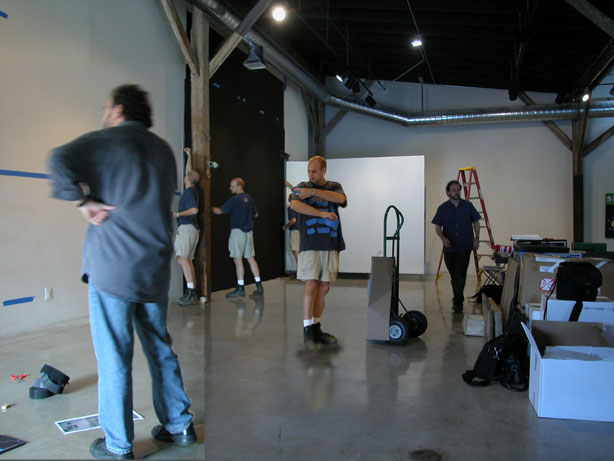
Randall Packer and I before the excavation of the grave two weeks ago in Athens. Or, fun with Photoshop. It's amazing what 20-25 minutes will get you between five snapss and reducing the image to 72dpi. Call it a draft.
Now before people e-mail in protest that I am ripping off Inigo Navarro Davilla at Irvine Contemporary Art, I'd just like to preface I've seen his kind of work before from a guy in New York a few years back by the name of Anthony Goicolea.
It's not the medium; it's what you choose to say with it.
Wednesday, September 13, 2006
America on the Brink: pt. Three
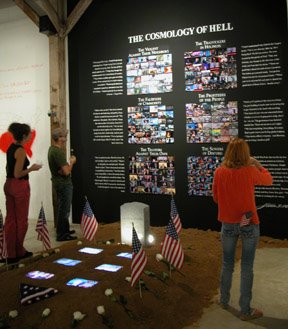
This has been my summer project. The extension of America’s Grave, which was first exhibited Jan 20th, 2006, one year after “the inauguration of death,” as my colleague and the creative director of the piece, Randall Packer, puts it. This is the piece as it went on display Sept. 9th, 2006, in Athens, GA.
The piece is fairly text heavy, between Randall’s blog chronicles
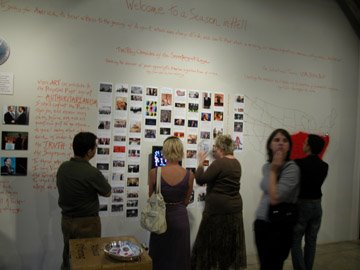 and my transcription of the cosmology of hell. We debated how attentive an audience would be to work that is so didactic. But they came in droves, stood, and read.
 The background on the piece, or how I don’t want the piece to be perceived as though we are raving lunatics: The Cosmology of Hell is based off of Dante’s Inferno. The original grave, as created by the US DAT, depicted six levels of hell: 1) The Violent Against Their Neighbor, 2) The Traffickers of Holiness, 3) The Falsifiers of Commodity, 4) The Profiteers of the People, 5) The Traitors Against Their Own, & 6) The Sowers of Discord. These levels of hell are represented through the media with television clips from 1) 9-11, Iraq, Afghanistan, Palestine; 2) crooked televangelists; 3) Supernatural Commercials; 4) Katrina; 5) The Administration; 6) Bill O’Reilly.
My job, when I first started working with the Department was to scrub, capture, and edit video and concoct a way to bury the monitors and DVD players in the dirt so they could last a run of two months.
For Athens, the piece had already expanded and additional narratives were included. The Cosmology of Hell had to be included. Below is the text on the wall, pulled from the audio clips of America’s Grave. The audio of the grave is designed in such a matter to allow chance. All six monitors are edited to different lengths, and the audio levels are raised and lowered to emphasize specific sound clips. All six monitors could play at once or the grave can go silent. Relationships form between them. The text below is an attempt to create a discordant linear narrative of the piece, as interpreted by a character I adopted for the trip to Lynchburg, VA: John 3:16. The numbers, which were originally reflective of the order of specific quotes extracted from their various levels of hell, have become an arbitrary assignment, but a deliberate visual aesthetic that communicates how text, even those of wholly writ, when removed from their source, or taken out of context, can be completely polluted of their intention and meaning.
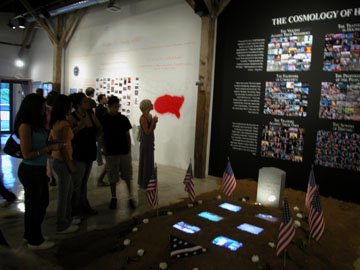
1.1Oh my God. The mighty World Trade Center tumbling down. People saying I love you and then the line going dead. The loss of life is utterly unbelievable. 1.2Today they brought that terrible hatred to the United States of America. 1.3Very seldom a military plan goes according to plan. We are going to have to hold everyone accountable. 1.4Enduring freedom is an inexpensive operation, estimated at less than $2.5 billion. 1.5Allah be praised, it’s a win-win situation -- I hope I live.
2.1I don’t understand why God let this happen to me. 2.2Aww you dummy. Shut up! He’s being God! We did not evolve. We were created by the genius of God. 2.3But, one misstep, one change in the direction of the wind, and I am into the abyss. 2.4There are good days ahead for each of you, I promise. You better get yourself ready. You profess Christ but you do not possess Christ. 2.5When you’ve lived your life and you’ve shared the good news of Jesus Christ... bombs away!
3.1Tell us what you don’t like about yourself. It’s time to start believing, start getting things back to normal the moment you call. 3.2The medicines. The plastic. The materials. Things that make modern life modern. Less of it is stored in the body as fat. 3.3 It’s not only brought us closer together but it has definitely deepened our faith. Order today. And see your world in high definition. 3.4I’m not putting it off a minute longer. This TV really sucks! You know what to do.
4.1I tell ya it’s gotten to the scary level here. I’m just looking to make sure we’re not going to get whacked in the head with anything. 4.2For those of you who are concerned about whether or not we’re prepared to help, don’t be - we are. The government has declared martial law. There are no more civil rights. 4.3We lost everything. Everything. It’s crazy. That’s gotta leave you feeling pretty helpless. 4.4This storm affects everyone. And Brownie, you’re doing a heckuva job!
5.1But we need to be alert. We will not tire. We will not falter. And we will not fail. 5.2There’s an old poster out west that said, “Wanted: Dead or Alive.” These demands are not open to negotiation or discussion. 5.3And then there came a day of fire. A fire in the minds of men. We will smoke them out of their holes. 5.4So help me god. My job is to protect America and that’s exactly what I’m gonna do, even though I walk through the valley of the shadow of death.
6.1This is World War Four: the war for the free world. It is an attack on American tradition. 6.2Be American. Celebrate Christmas. People spend more money. Jesus makes people want to spend money. 6.3This is what the culture war is all about. 6.4Generally we’re against rape. To an obsessive element, you know, It looks like it is harmless. It’s not. 6.5So, it’s down with Christmas & up with sexual offenders. Because they’re Liberals and they throw like girls. 6.6The American Media is working for the enemy.
Wednesday, September 06, 2006
America on the Brink: pt. Two
Monday and Tuesday have evaporated. 26 hours of installation and we still do not appear to be very far along. Transcribing the text of John 3:16 onto a 15'x13' wall takes time, however. Randall has busied himself with organizing and designing the wall devoted to the blog chronicles. More of that occurs today. Tomorrow we become, once again, grave diggers.
We were interviewed by the press on Monday. The author of the article asked, since there are so many Republicans in Georgia, how to go about writing this in such a manner so that it does not offend people. I suppose a grave with the death date of The USA coinciding with the second inauguration of W. can be a bit incendiary. We communicated to her that this is not an anti-Republican piece. The Republican Party is the party of Lincoln, Teddy Roosevelt and Eisenhower. Nor is this piece in opposition of religion. The piece opposes fundamentalism and the mixing of politics and religion, that the blind cowtowing to both is problematic.
When pursuing this piece it has been of great importance not to have it appear with the look of a political cartoon. Half of the gallery is filled with the work of other artists and some of them appear with the look of political cartoons. Text heavy and with a punchline. The one-liner. Take my president, please! Art and politics is a messy busy.
We were interviewed by the press on Monday. The author of the article asked, since there are so many Republicans in Georgia, how to go about writing this in such a manner so that it does not offend people. I suppose a grave with the death date of The USA coinciding with the second inauguration of W. can be a bit incendiary. We communicated to her that this is not an anti-Republican piece. The Republican Party is the party of Lincoln, Teddy Roosevelt and Eisenhower. Nor is this piece in opposition of religion. The piece opposes fundamentalism and the mixing of politics and religion, that the blind cowtowing to both is problematic.
When pursuing this piece it has been of great importance not to have it appear with the look of a political cartoon. Half of the gallery is filled with the work of other artists and some of them appear with the look of political cartoons. Text heavy and with a punchline. The one-liner. Take my president, please! Art and politics is a messy busy.
Subscribe to:
Posts (Atom)

 Posts
Posts


